

The Phillips Memorial, Godalming: A Place of Courage, Quiet & Connection
Part 1 of our ChoirBLAST ‘Stages’ Focus
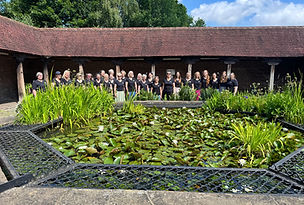
One of our favourite ChoirBLAST stages, The Cloisters, sits in a spot with a beautifully layered story. It is a place where memory, landscape and community intertwine, and where voices seem to find a natural home.

Within the Phillips Memorial Park, named after John George “Jack” Phillips, a young man from Farncombe in Godalming who played a remarkable role in the tragic sinking of the Titanic in April 1912, three of our stages are located, with the Cloisters forming a permanent architectural feature. Nestled at the heart of the park, they create a gentle hub within the wider festival, moments of sound and stillness linked by paths, people, craft stalls and the welcome bustle of food and drink nearby.
Jack Phillips was just 25 years old when he went down with the ship, having remained at his post to the end. His courage and determination helped save hundreds of lives, securing his place in history as one of the disaster’s quiet heroes.
Jack was the Chief Wireless Telegraphist aboard the Titanic, part of the Marconi Company team responsible for transmitting messages by Morse code. On the night the ship struck an iceberg and began to sink, he stayed at his post far beyond what was expected, sending out CQD and the newly adopted SOS distress calls to nearby vessels, urging them to come to the stricken liner’s aid. His persistence, even in those final hours, was credited with helping to save hundreds of lives.
Two years later, Jack’s community came together to commemorate that self-sacrifice in a way that matched both his roots and the spirit of the time.
A Memorial Born of Heart & Craft
In 1913–14, local people raised funds by public subscription to build what has become the largest Titanic memorial to a single person in England.
Designed by Hugh Thackeray Turner, a local architect celebrated for his work in the Arts and Crafts style, a design ethos rooted in craftsmanship, harmony with nature and meaningful detail, the memorial takes the form of a brick and tile cloister set beside the tranquil River Wey. Its enclosed arches create a naturally resonant acoustic, allowing voices to gather, carry and linger in the air.
Inside and around the cloister, the gardens were laid out by Gertrude Jekyll, one of Britain’s most influential garden designers. Her planting favours soft textures and natural rhythm over rigid formality. It is a romantic setting that, in spring and summer, is enriched by colour, scent and the quiet drama of climbing wisteria. It is a space that invites pause, reflection and song.

The cloister was officially unveiled on 15 April 1914, exactly two years after the Titanic went down. There is an inscription on the stone tablet inside that reads simply but powerfully:
“SOS. This cloister is built in memory of John George Phillips, a native of this town, Chief Wireless Telegraphist of the ill-fated S.S. Titanic. He died at his post when the vessel foundered in mid-Atlantic on the 15th day of April 1912.”
Originally, a lily pond and fountain lay at its centre, gifts from the Telegraph Clerks’ Association. Though the space has evolved over time, a restored fountain and the surrounding planting still echo Jekyll’s original intentions, with water, stone and sound held together in balance.
A Park That Breathes With Life
More than just a memorial cloister, the wider park, now spanning around 4.5 hectares (11 acres) and recognised with a Green Flag award, offers a lively public space that comes into its own during the festival.
Meander along the picturesque riverbank, move between stages, browse the craft stalls, pause for food, or settle beneath the arches as music drifts across the park. Watch children playing near the bandstand, see skaters at the skate park, or stop by the conservation meadow and pond. You might even spot the Godalming War Memorial nearby, another reminder of community, service and sacrifice etched into this corner of Surrey.
In 2012, for the Titanic’s centenary, the cloister and gardens were lovingly restored with Lottery funding, and the planting was reimagined with reference to Jekyll’s original vision, blending heritage with living colour.

Why It Matters
So when you’re here between sets, wandering along the riverbank, resting beneath the arches, letting the sound of singing rise and return, you’re not just in a pretty park. You’re in a space born of courage, connection and collective memory.
Jack Phillips didn’t just send messages into the night. He embodied a commitment to the wellbeing of others that still resonates more than a century on. When voices gather here now, framed by stone, water and sky, they become part of that continuing story... whether by taking part in the festival, visiting it, or sponsoring a stage here – including this one.
In every patch of planting and curve of stone, there is a story, one rooted in this very ground, and one worth carrying with you as you sing, listen, and move through the festival together.


